
Guide
Why a Garage Door Goes Off Track Here
Blue Springs homes built mostly in the 1960s-70s have original track hardware that shifts with cold winters. Here's what actually knocks a door off its rails.
Local detail
What Is Going On
A door comes off track when the rollers slip out of the steel channel that guides them up and down. It usually doesn't happen all at once. The bracket that holds the track to the framing works loose a fraction at a time, or a roller wears down until it no longer sits flush in the channel, and one day the door binds, jumps the rail, or drops crooked in the opening.
In Blue Springs this shows up more than you'd expect because so much of the housing stock here dates to 1951-2005, with the bulk of it built through the 1960s and 70s. That means a lot of garages still running the original steel track and the original mounting brackets bolted into framing that's now fifty-plus years old. Wood shrinks, screws back out a little, and the tolerance between roller and rail gets sloppier every year nobody's checked it.
A door that's been quietly riding loose track for months will often look fine right up until the morning it doesn't come down straight. That's usually the point where a homeowner calls, not before.
The area
What Changes With the Season
Blue Springs sits in a cold-moderate climate band, and that swing matters more to a garage door than most people think. Steel track and steel rollers both contract when the temperature drops, and on a door that's already got some slack in the bracket, a hard freeze is often what turns a minor misalignment into a door that binds or jumps the rail entirely.
It's not usually the door itself failing. It's that the metal-to-metal tolerances that were fine in August get tighter in January, and hardware that was one bad roller away from slipping finally slips. This is why the calls tend to cluster in the cold months even though the underlying wear happened all year.
On the other side of the year, humidity and heat can do the opposite: wood jambs swell slightly and can push a track bracket out of true if it wasn't shimmed well to begin with. Either direction, the track is the part paying for temperature swings the rest of the house barely notices.
What we find
How Local Conditions Play In
Most of the houses on this side of the metro were framed in the 1960s and 70s, and garage construction from that era leaned on lighter track brackets than what goes in new builds today. Those brackets were adequate for the doors of the time, but decades of seasonal movement in a cold-moderate climate have loosened plenty of them.
If your house falls in that build window, and a lot of homes here do, the odds are decent that nobody's swapped the original track hardware since the door went in. That's not a knock on the build - it's just what fifty years of freeze and thaw does to fasteners nobody revisits until something goes wrong.
Newer construction in town, closer to the 2005 end of that range, tends to have heavier gauge track and better-anchored brackets, so the failure pattern shows up less there. Age of the structure is a better predictor of a track problem than anything else we look at on a call.
How we work
What to Check
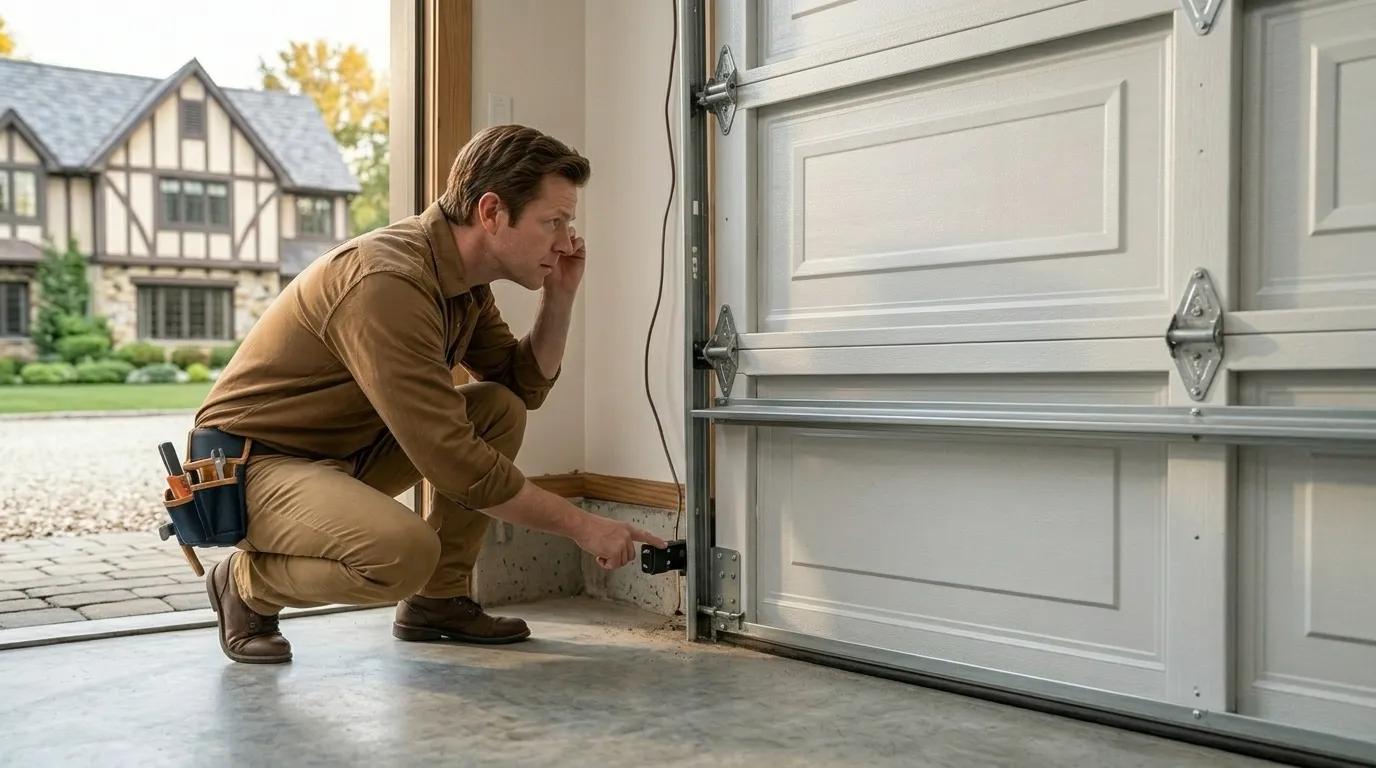
Before you call anyone, look at three things. First, the brackets bolting the track to the wall framing - give them a shake by hand. If there's play, that's often the whole problem. Second, look at the rollers themselves where they sit in the channel; a roller that's worn to an oval instead of a circle will ride rough and eventually jump. Third, check for a gap between the track and the wall that isn't even top to bottom - an uneven gap usually means a bracket has already shifted.
One honest limitation here: if the track itself is bent, not just loose, that's not a tighten-the-bolts fix. Bent track on an older door usually means replacing that section, and on hardware this old, matching gauge and profile isn't always straightforward. We'll tell you straight if that's where you're at instead of patching something that'll just fail again in a season.
If you're not sure what you're looking at, that's a fair reason to get someone out to look before the door drops.
Questions
Common questions
Why did my garage door suddenly come off the track this winter?
Cold contracts steel track and rollers, which tightens tolerances that were already loose from years of bracket wear. In a cold-moderate climate like Blue Springs, that's often the tipping point - the hardware was marginal all year and the freeze is what finally pushed it over.
Is an off-track door always a full replacement?
No. Often it's a loose bracket or a worn roller, both fixable without replacing the door. It becomes a bigger job only if the track itself is bent, which is more common on original hardware from 1960s-70s construction that's never been serviced.
My house was built in the 70s - does that matter?
Yes. A large share of homes in Blue Springs date from the 1960s and 70s, and many still run original track brackets sized for lighter doors of that era. That age is the single biggest factor we see in off-track calls.
Can I just push the door back onto the track myself?
You can sometimes reseat a roller by hand if the track isn't bent, but a door under spring tension is dangerous to force. If the bracket is loose or the track is out of true, pushing it back on is a temporary fix at best.
Ready when you are
Need a garage door sorted in Blue Springs?
Blue Springs Garage Door Pros repairs and installs garage doors, springs and openers in Blue Springs, MO and the surrounding area.