
Guide
What That Noise Coming From Your Garage Door Actually Means
Blue Springs homes built mostly between 1951 and 2005, with a heavy 1960s-70s cluster, develop specific noises as original hardware ages through cold winters. Here's what each sound tells you.
Local detail
What Is Going On
Most of the noise calls we get trace straight back to the age of the house, not the age of the opener. A lot of Blue Springs was built between 1951 and 2005, and the biggest single cluster of that stock went up in the 1960s and 70s, spread across the 22 named areas that make up this side of the county. That generation of door came with steel rollers riding in steel tracks, torsion springs mounted the way builders did it back then, and hardware that was never meant to last past a couple of decades without attention.
A grinding sound usually means metal rollers that have worn flat on one side, common in houses from that build era where nobody ever swapped the originals for nylon. A sharp bang, usually once, is a spring letting go - and on a house this old, if it hasn't been replaced yet, it's original or close to it. A rhythmic thump as the door travels is almost always a bent track section or a roller that's finally given out after fifty-plus years of the same door going up and down.
A loose rattle, especially near the top of the travel, is often just hardware that's worked itself loose over decades - bolts on an opener bracket, a bent hinge, or a panel seam that's flexed one too many times. None of these mean the door is done. Most mean it's asking for the kind of attention nobody's given it since the house was built.
The area
What Changes With the Season
Blue Springs sits in a cold moderate climate band, and that shows up in the noise your door makes long before it shows up in anything else. Steel contracts in the cold. Grease that moved fine in July turns thick and sluggish once temperatures drop, and a door that ran quiet all summer starts groaning through its full travel the first hard freeze of the season.
Springs behave differently too. Cold steel is stiffer and less forgiving, so a spring that was already fatigued from years of cycling is far more likely to snap in the cold months than in the warm ones - that's why the loud bang calls cluster up as winter sets in. Openers can start making a new grinding sound as gear sets, worn from years of summer heat expansion and winter contraction, finally slip a tooth.
We also get calls about a new squeak that shows up only in the first cold snap and then seems to fade. That's usually moisture and temperature working on a hinge or roller that was already marginal - the noise doesn't go away, it just becomes less noticeable once you get used to it, which is worse, not better. A door that's noisy specifically when it's cold is telling you exactly where to look.
What we find
How Local Conditions Play In
With roughly 35,651 owner-occupied houses across this service area and a median household income of $71,881, most of what we see on service calls is original or near-original hardware that's simply reached the end of its working life, not damage from a storm or an accident. The noise is the door telling you the parts have worn out on schedule.
The age spread matters more than people expect. A house from the 1974 median build year has had roughly fifty years of the same door opening and closing, in a climate that swings from summer heat into hard winter freezes every single year. That cycle of expansion and contraction is what loosens hinge bolts, dries out lubrication, and wears rollers unevenly - it's mechanical fatigue, not a one-time event.
Grain Valley sits just three miles off, and it shares the same 1960s and 70s build years, which is part of why we hear the same complaints repeated across that stretch of the county - the grinding roller, the bang from a spring, the thump from a worn track. It's not coincidence. It's the same hardware, installed in the same decade, aging on the same clock.
How we work
What to Check
Before you call anyone, a few things you can look at yourself. Watch the door move through a full cycle in daylight. A grinding roller usually shows visible wear - flat spots, chunks missing, or a roller that wobbles instead of spinning true. A loose track bolt or bent bracket is often visible just by running your hand along the track while the door is closed.
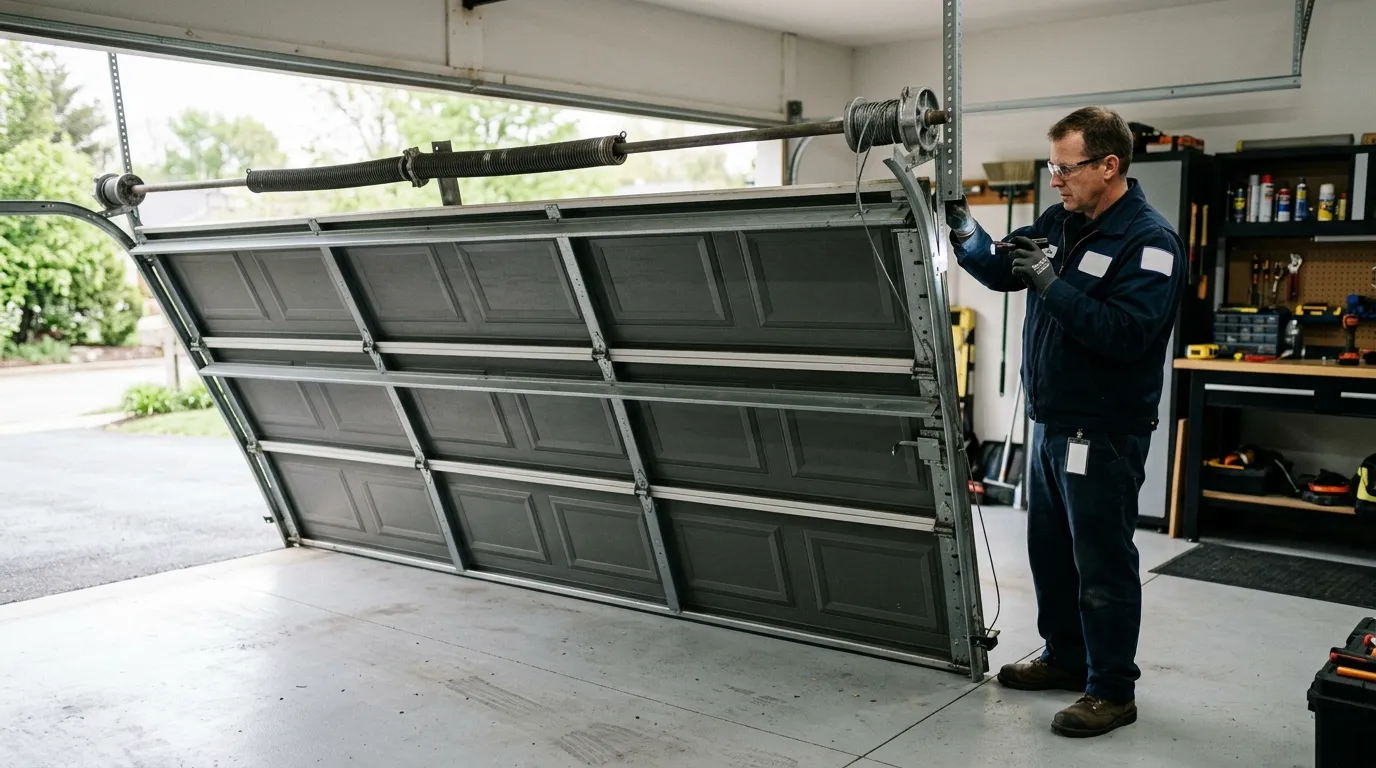
Listen for where in the cycle the sound happens. Noise only at the very top or bottom often points to the opener's travel limits or a worn belt or chain, not the door itself. Noise through the whole run points to rollers or track. A single loud bang with the door refusing to open points to a spring, and that's not a DIY fix - the tension involved can hurt someone who doesn't do this for a living.
One honest limit here: we can't diagnose a noise over the phone with any real confidence. Age and sound point us in a direction, but a fifty-year-old spring and a fifty-year-old opener gear can make noises that sound almost identical. If the door is original to a house from the 1960s or 70s, expect that a service call may turn into a conversation about whether it's worth repairing versus replacing the aging parts outright.
Questions
Common questions
Why does my garage door grind more in the winter?
Cold steel is stiffer and grease thickens in low temperatures, so rollers and gears that ran fine in summer start grinding once the cold sets in. Blue Springs' cold moderate climate means this shows up every year, especially in houses with original hardware from the 1960s or 70s.
My house was built in the 70s and the door bangs loudly sometimes. Is that a spring?
Almost certainly. A single loud bang is the sound of a torsion spring failing, and houses from that build era across Blue Springs often still have original or near-original springs. Don't try to open the door manually until it's been checked - the tension is dangerous to handle without the right tools.
Can a rattling door just be tightened up, or does it need replacing?
Often it's just loose hardware - bolts, hinges, or an opener bracket that's worked free over decades of use. We can't say for certain without seeing it, but a rattle alone usually doesn't mean replacement. A door that rattles and also grinds or bangs is a different story.
Ready when you are
Need a garage door sorted in Blue Springs?
Blue Springs Garage Door Pros repairs and installs garage doors, springs and openers in Blue Springs, MO and the surrounding area.