Pleasant Hill, Blue Springs

Garage Door Repair for Pleasant Hill's Newer Housing Stock

Pleasant Hill homes mostly went up after 1993, a generation newer than the Blue Springs stock we usually work on - that gap changes what breaks and how we fix it.

Garage Door Repair for Pleasant Hill's Newer Housing Stock in Blue Springs
Serving Blue Springs, MOBackground-checked techsHonest, upfront pricingFast local response

Local causes

Why This Fails Locally

Blue Springs, where we're based, is full of doors built to 1960s and 70s spec - F1 puts the wider service area's median build year at 1974. Pleasant Hill runs newer. The median year built here is 1993, closer to two decades younger than what we see back at the shop. That gap matters more than it sounds like it should.

A door installed in the early 90s is past its factory-rated cycle count on the springs even if nobody's touched it, and the openers from that era are chain-drive units with logic boards that have quietly failed capacitors or worn drive gears - not the fully mechanical relay systems from the 60s stock. The rollers are usually still steel, not nylon, because composite rollers didn't get standard until later, so the noise complaints we get from this town sound different than what we hear closer to home. We're driving the 14 miles out from Blue Springs already expecting a newer torsion setup and a newer opener, not older hardware patched together over decades.

Why This Fails Locally

DIY or pro

Can You Do This Yourself

Some of it, yes. If the opener won't respond, check the wall switch wiring and the safety sensor alignment first - on a door from the 90s those sensors are standard equipment and a knocked-out-of-line sensor is the single most common no-go we find on a service call.

Seasonal roller maintenance

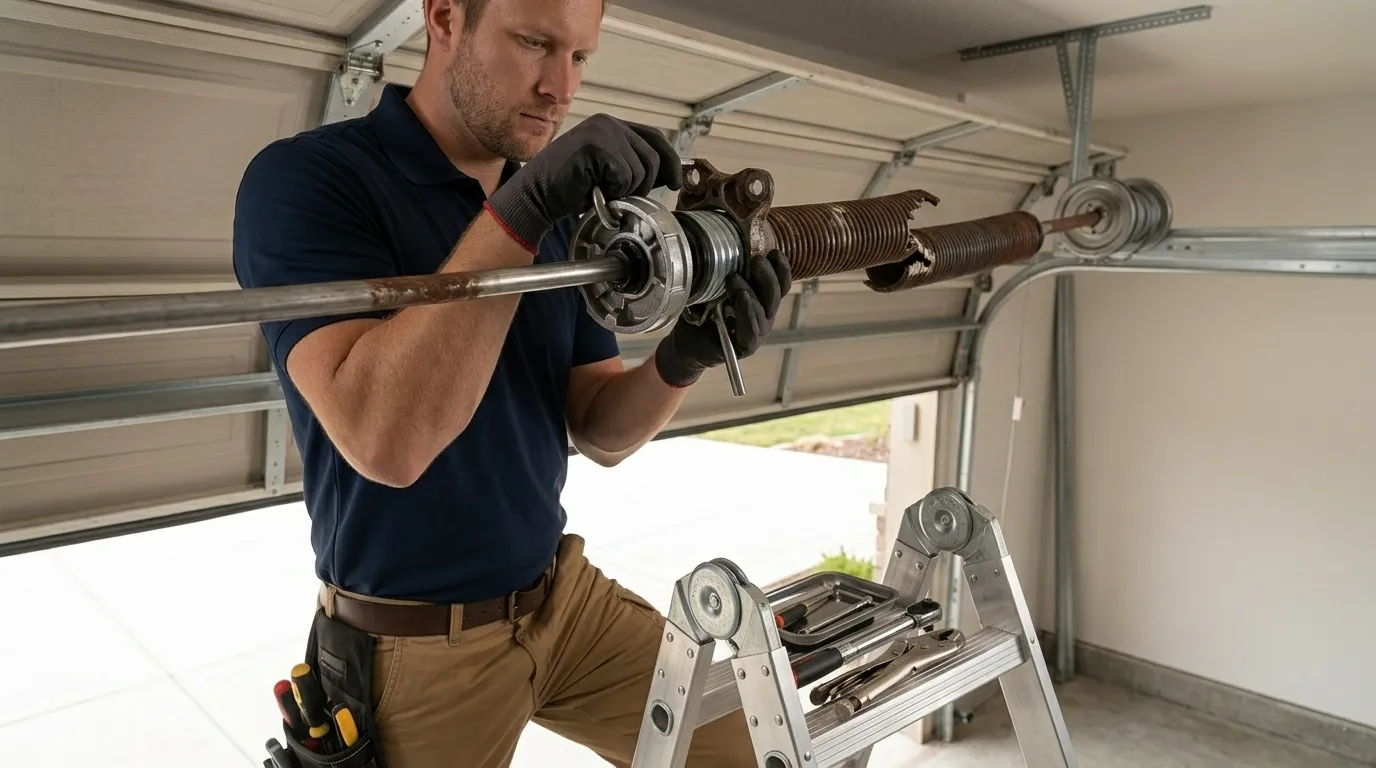
Cleaning and lubricating rollers and hinges is fair game for anyone with a ladder and an afternoon. What you shouldn't touch: torsion springs, period. On a door built in this era the spring is wound tighter than an older low-tension setup, and it's under enough load to break a wrist or worse if the winding bars slip.

Cable fraying replacement limit

Cable replacement is the same story - one frayed strand under tension is not a DIY repair. If the door won't move at all and the springs look intact, it's usually the opener, not the door, and that's worth a call before you start pulling panels apart.

How It Shows Up

Warning signs

How It Shows Up

The most common complaint we hear from this side of the service area is a door that opens partway and reverses, which almost always traces back to the opener's travel limits or a sensor that's drifted out of alignment - both common failure points on the chain-drive units installed through the 90s and early 2000s. Second most common: a grinding or slapping noise at one specific point in the door's travel, which usually means a bent track section or a roller that's worn through its bearing.

We don't see as many snapped one-piece doors out this way as we do on the older stock closer to Blue Springs, because sectional doors with individual panels were already standard by the time most of Pleasant Hill was built. When a panel does crack, it's usually from an impact - a car bumper, a basketball - rather than age fatigue.

The repair

What the Fix Involves

A torsion spring replacement on a door from this era means matching the wire gauge and wind to the door's weight, which is more standardized on 90s-and-later doors than on the mixed hardware we find on older houses, so parts matching tends to be faster once we're on site.

Logic board diagnostic protocol

Sensor and opener logic board work is a diagnostic job first - we check voltage at the board before assuming the motor itself is bad. Track and roller work means pulling the door off its hinges section by section, straightening or replacing the bent run, and reseating the rollers with the door supported so it doesn't drop.

Newer torsion system advantage

None of this is a five-minute fix regardless of the door's age, but a newer torsion system generally comes apart and goes back together cleaner than the older side-mounted hardware we work on elsewhere.

What Can Go Wrong

Watch-outs

What Can Go Wrong

The honest limitation: if the opener's logic board has failed outright, we often can't get an exact replacement board same-day - parts for openers from the 90s and early 2000s aren't always stocked locally, and depending on the brand it can mean a short wait. A full opener swap is sometimes the faster and cheaper call than waiting on a discontinued board.

On the spring side, the risk is a mismatched spring - too light and the opener strains and burns out early, too heavy and the door slams up. We size to the door's actual weight, not a guess. And any time a cable's been under tension and starts to fray, waiting on it isn't a savings move; it becomes a bigger repair, sometimes with the whole assembly needing replacement instead of just the cable.

Pricing

The Cost of This Job

We don't have a published price list here, and job cost depends on the specific hardware and how far things have gone before the call comes in. What we can say from the numbers we do have: median household income across the wider service area is $71,881, but Pleasant Hill runs well above that at $94,840, and homes here are newer and generally in better original condition than the older stock in the service area's core. That combination usually means a repair rather than a full replacement is the right call, since the door structure itself is younger and the failure is more often a single part - a spring, a sensor, a section of track - than the whole system aging out at once.

The Cost of This Job

Questions

Common questions

Why does my opener from the 90s act different from what my neighbor in an older house has?

Openers installed through the 90s and early 2000s are mostly chain-drive units with electronic logic boards and standard safety sensors - different failure points than the older mechanical relay systems on houses built before then. Sensor misalignment and board issues are the common problems on your generation of hardware; snapped springs and worn manual latches are more common on older setups.

Do you have a shop in Pleasant Hill?

No, we're based in Blue Springs, about 14 miles out, and drive to Pleasant Hill for calls. We don't run a local branch here, so we're not able to promise a same-day window the way we might closer to the shop.

Is it cheaper to fix the opener or replace it?

Depends on what's actually wrong. If it's a sensor or a worn drive gear, repair is usually the cheaper route. If the logic board itself has failed and the model is old enough that the exact board isn't easy to source, a full opener replacement can end up being the faster and more sensible option.

My door reverses partway up - is that a spring problem?

Usually not. On doors from this era, a partial-open reversal is almost always the opener's travel limit setting or a misaligned safety sensor, not the spring. Springs failing tend to show up as a door that won't lift at all, or one that feels far heavier than usual when you try to move it by hand.

Ready when you are

Need a garage door sorted in Blue Springs?

Blue Springs Garage Door Pros repairs and installs garage doors, springs and openers in Blue Springs, MO and the surrounding area.

CallGet a quote